
A Transparent Look at How Two Way Mirrors Are Made
What You Need to Know About How Two Way Mirrors Are Made
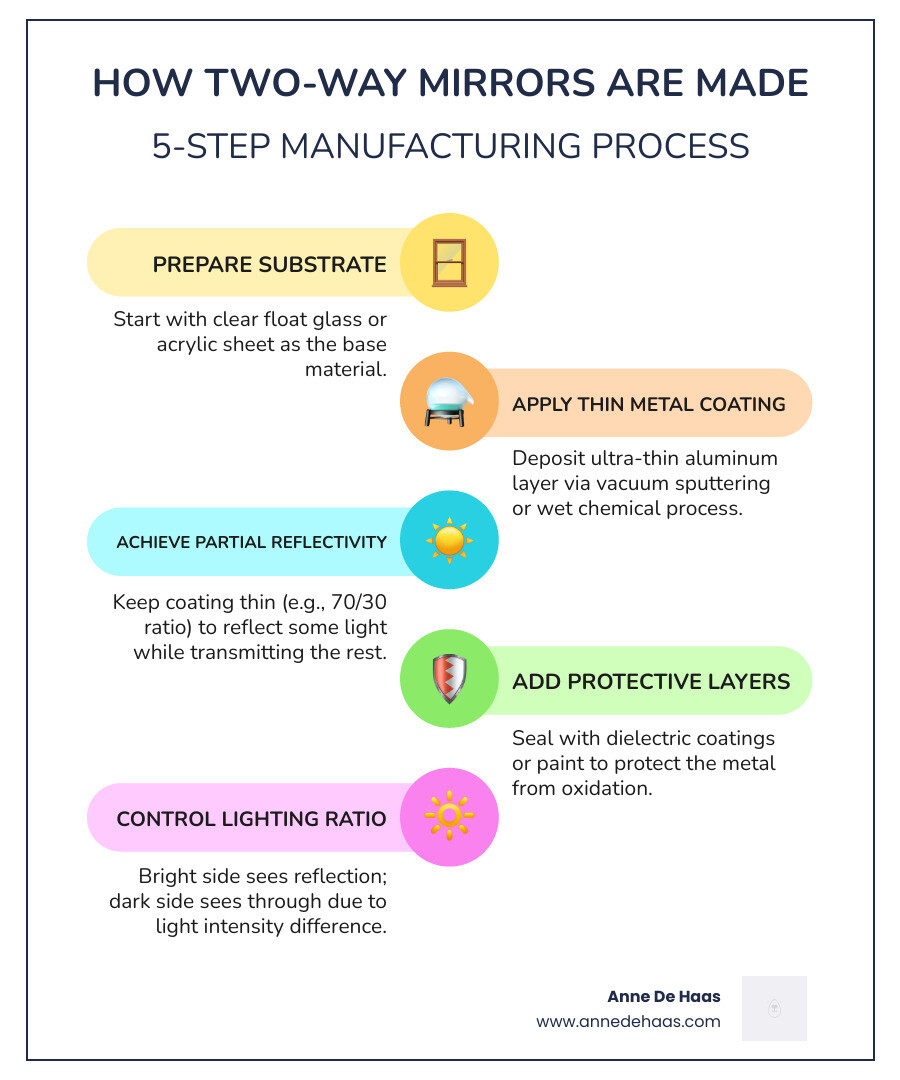
How are two way mirrors made is simpler than most people expect. Here’s the short answer:
- Start with a substrate — either glass or acrylic sheet
- Apply a thin metal coating — usually aluminum, deposited in a vacuum chamber or via a wet chemical process
- Keep the layer ultra-thin — just thick enough to reflect some light, but still let the rest pass through
- Add protective layers — paint or dielectric coatings seal and protect the metal
- Control the lighting — the one-way effect only works when one side is brighter than the other
That’s the core of it. Unlike a standard mirror, where the metal coating is fully opaque, a two-way mirror uses a partial coating — reflecting roughly 70% of light while letting about 30% pass through.
The result? Stand on the bright side and you see your reflection. Stand on the dark side and you see straight through.
This technology has been around longer than most people realize. The first U.S. patent for a “transparent mirror” was filed back in 1903. Today, the same fundamental principle powers everything from police interrogation rooms to smart home mirror displays.
Whether you’re planning a DIY smart mirror build or just curious about the optics, this guide walks through the full manufacturing process — from industrial vacuum deposition to at-home film methods.
The Science of Partial Reflectivity
To understand how are two way mirrors made, we first have to look at the physics of light. In a standard household mirror, a thick layer of silver or aluminum is applied to the back of the glass. This layer is completely opaque; it reflects almost 100% of the light that hits it.
A two-way mirror (also known as a one-way mirror) is different because it is “half-silvered.” We apply the metallic coating so thinly that it becomes semi-transparent. This creates a bidirectional surface where light passes equally in both directions.
Wait—if light passes equally both ways, why does it look like a mirror on one side and a window on the other?
The secret is lighting contrast. For the effect to work, the “subject” side must be brightly lit, while the “observer” side must be kept dark.
- On the bright side, the amount of reflected light is so intense that it overwhelms the small amount of light coming through from the dark side.
- On the dark side, there is very little reflection to see. Instead, the observer sees the abundant light coming through from the bright room.
In technical terms, these mirrors often operate on a 70/30 or 60/40 ratio. For example, a 70/30 mirror reflects 70% of the light and transmits 30%. When photons strike the silver backing, their behavior depends entirely on the thickness of that metal layer. As noted in How are mirrors made? – history and manufacturing methods, the quality of the reflection depends on the smoothness of the surface and the precision of the coating.
How Are Two Way Mirrors Are Made? The Industrial Process
In a professional manufacturing environment, the process is a high-tech dance of chemistry and physics. While ancient mirrors were made of polished obsidian or bronze, modern versions use a process called vacuum deposition.
1. Preparing the Substrate
We start with high-quality float glass or optical-grade acrylic. The surface must be perfectly flat and surgically clean. Any speck of dust or oil will cause the metal coating to peel or bubble. Industrial cleaners and deionized water are used to ensure a “virgin” surface.
2. The Vacuum Chamber
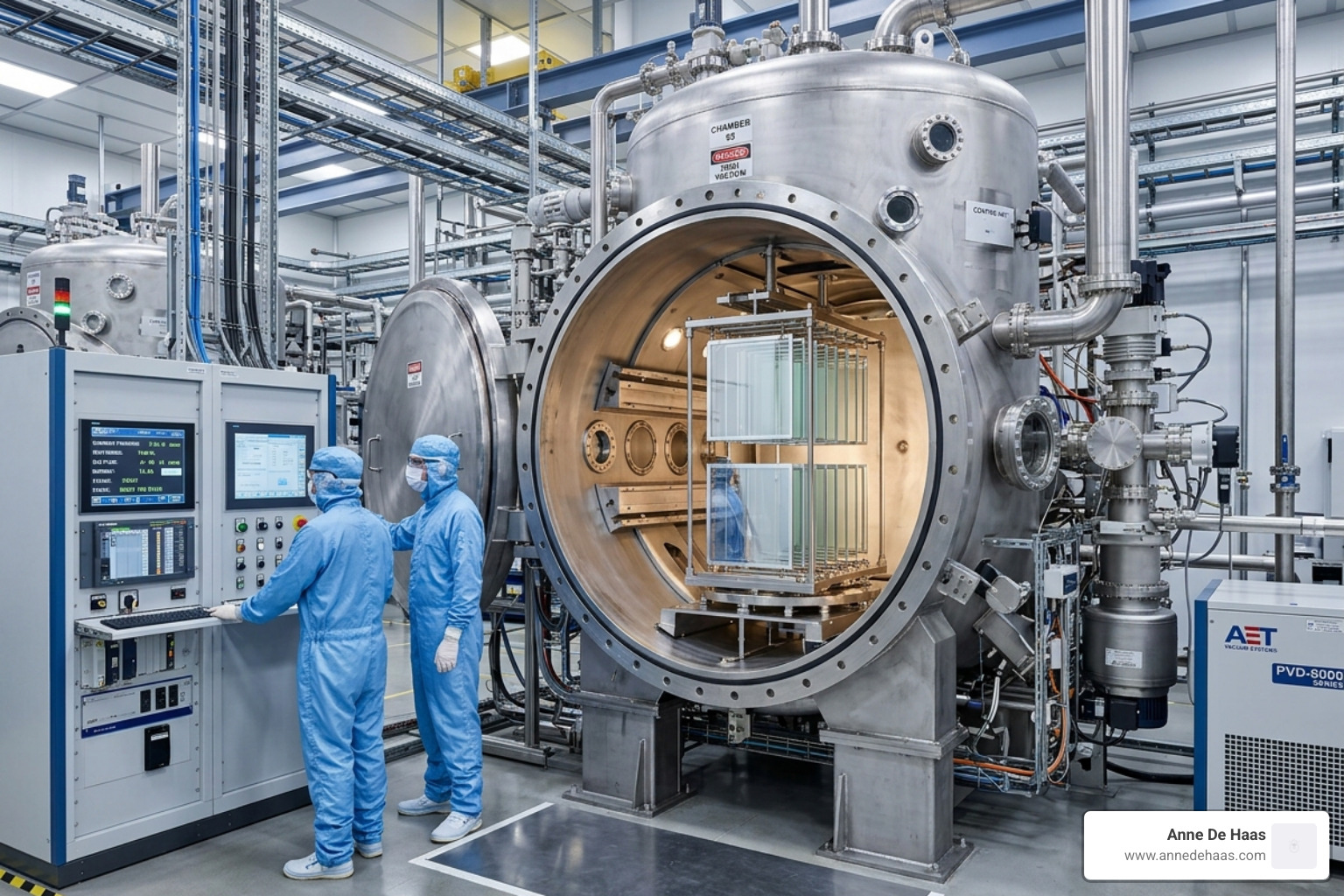
The glass is placed inside a massive vacuum chamber. All the air is sucked out to create a near-perfect vacuum. This is crucial because it allows metal atoms to travel in a straight line without bumping into air molecules.
3. Aluminum Deposition
Inside the chamber, a metal—usually aluminum—is heated until it vaporizes. Because there is no air, the aluminum “mist” coats the glass evenly. For a two-way mirror, the timing is everything. We stop the process when the layer is only a few atoms thick. This allows the mirror to maintain its transparency while providing the highest level of reflection in the ultraviolet and infrared spectral ranges.
4. Dielectric Coatings and Sputtering
To make the mirror more durable, manufacturers often add dielectric coatings. These are non-conductive layers (like silicon oxides) that are only 1/10,000th of an inch thick. According to How mirror is made – material, manufacture, making, history, used, parts, procedure, steps, product, these layers help prevent oxidation and increase scratch resistance. In some advanced setups, a process called “sputtering” uses ions to knock metal atoms onto the glass, creating an even more resilient bond.
Materials and Variations: Glass vs. Acrylic
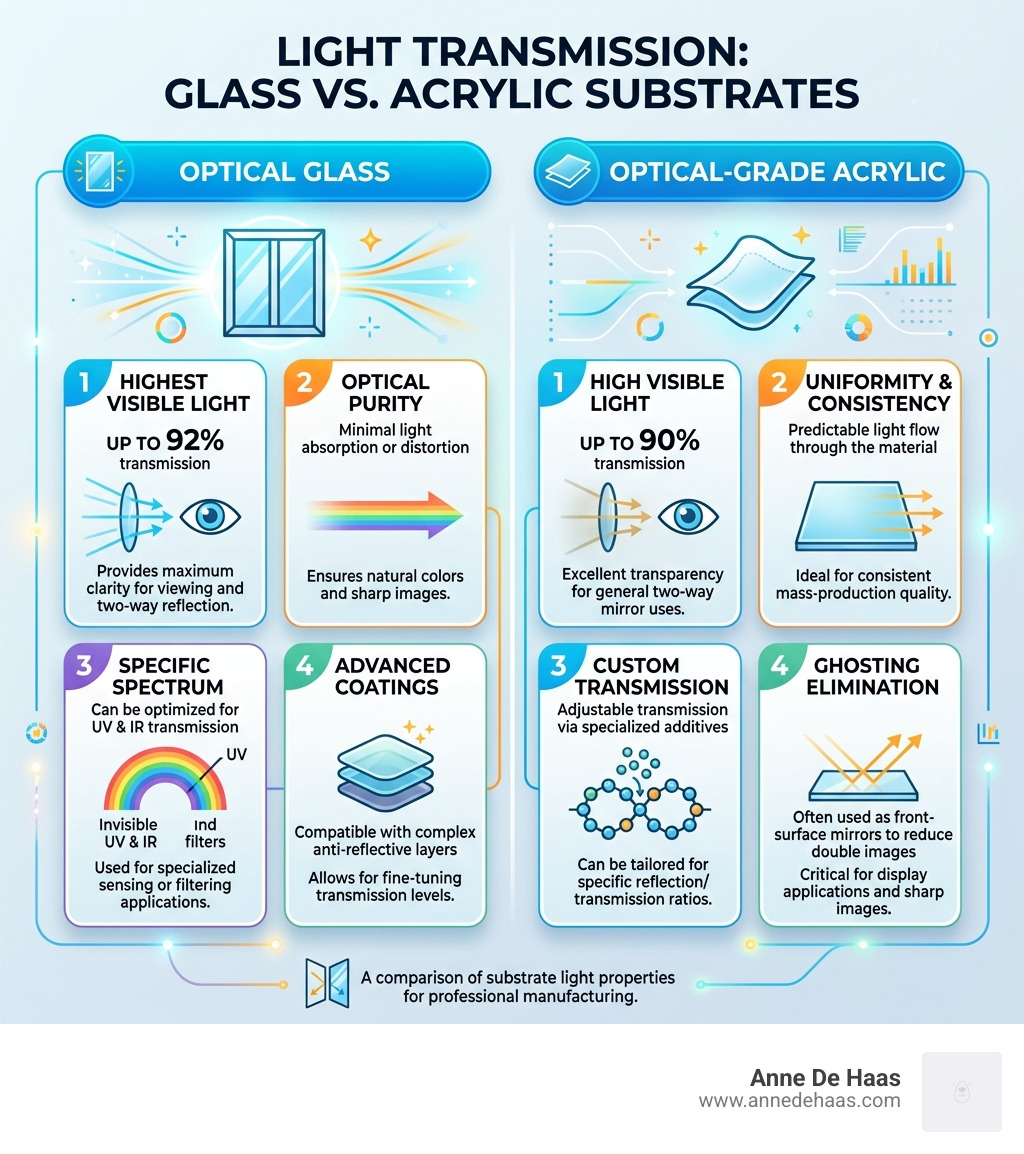
When deciding how are two way mirrors made for a specific project, the choice of material (the substrate) is vital. We generally work with two main types: Glass and Acrylic.
| Feature | Glass Two-Way Mirror | Acrylic Two-Way Mirror |
|---|---|---|
| Durability | High (scratch resistant) | Moderate (prone to scratches) |
| Weight | Heavy | Lightweight |
| Optical Clarity | Excellent | Good (can have slight distortion) |
| Safety | Can shatter (unless tempered) | Shatter-resistant |
| Best Use | Permanent installations, Interrogation rooms | DIY projects, Smart mirrors, Displays |
Acrylic mirrors are particularly interesting because of their “lattice” structure. The aluminum oxide coating is sprayed over the acrylic, and then a clear finish is applied. This creates a microscopic grid that allows light to pass through. As Two Way Mirror | Manufacturer of Optical Glass & Acrylic points out, acrylic is often the preferred choice for “front surface mirrors,” which eliminate the “ghosting” or double-image effect seen in standard back-silvered glass.
DIY Methods for Mirror Construction
If you don’t have access to a vacuum chamber (and let’s be honest, most of us don’t), you can still create a functional two-way mirror at home. At Anne De Haas, we love helping people turn these concepts into reality.
Essential DIY Tools:
- Glass or acrylic sheet
- Two-way reflective film or a silvering kit
- Squeegee and application solution (soapy water)
- Microfiber cloths
- Safety goggles and gloves
How Are Two Way Mirrors Made with Silver Nitrate?
This is the “wet deposition” method, and it’s a bit like a high-school chemistry experiment. You start by “tinning” the glass with tin salts, which helps the silver stick. Then, you spray a solution of silver nitrate combined with a chemical reducer.
As the silver nitrate is reduced, metallic silver bonds to the glass. To make it a two-way mirror, you must apply the solution sparingly and evenly. Unlike standard mirrors that use copper-free protection and two layers of paint to become opaque, we leave the silver layer exposed or cover it with a very thin, clear protective sealer. How Mirrors Are Made: The Process of Creating Mirrored Glass with Silver and Copper Coating notes that modern copper-free methods are much more resistant to humidity, preventing that “cloudy” look that ruins many DIY projects.
How Are Two Way Mirrors Made Using Reflective Films?
This is the most accessible method for DIYers. Reflective film is typically made of PET plastic with a metallic layer sandwiched inside.
- Clean the surface: Any tiny speck will look like a mountain under the film.
- Wet the surface: Use a spray of water and a drop of dish soap.
- Apply the film: Lay the film over the glass. The water allows you to slide it into the perfect position.
- Squeegee: Start from the center and push the water out to the edges.
- Heat: Use a heat gun on a low setting to remove any remaining wrinkles and ensure a tight bond.
This method is shatterproof and cost-effective, making it great for experimental art or temporary security setups.
Practical Applications and Installation
Understanding how are two way mirrors made opens up a world of creative possibilities. We see these used in everything from high-stakes security to home decor.
- Smart Mirrors: By placing a tablet or monitor behind a two-way mirror, you can see the time, weather, and your calendar “inside” the glass while you brush your teeth.
- Teleprompters: News anchors read their scripts from a screen reflected on a two-way mirror, while the camera sits behind the glass, filming right through the text.
- Infinity Mirrors: By placing a two-way mirror in front of a standard mirror with an LED strip in between, you create an optical illusion of a never-ending tunnel of light.
- Hidden TVs: You can hide a television in plain sight. When the TV is off, it looks like a decorative mirror. When on, the brightness of the screen overcomes the reflection.
Pro-Tip for Installation: If you are using a camera behind the mirror, position the lens 1 to 2 inches away from the glass. If the camera is too close or too far, the auto-focus might get confused by the “lattice” structure of the metallic coating. As mentioned in All about two-way mirrors., maintaining a dark environment behind the camera is the most important factor for clear visibility.

Frequently Asked Questions about Two-Way Mirrors
How do you tell if a mirror is two-way?
The most famous way is the “fingernail test.” If you touch a standard mirror, there is usually a small gap between your finger and the reflection (because the silver is on the back of the glass). On many two-way mirrors, the coating is on the front, so your fingers will appear to touch. However, the most reliable way is to look for a lighting disparity. If you can cup your hands against the glass and see through to a darker room, it’s a two-way mirror.
Can you see through a two-way mirror at night?
Yes, but the effect might reverse! If it is dark outside and you turn on bright lights inside your house, a two-way mirrored window will act as a mirror for you, but people outside will be able to see in perfectly. The “one-way” effect always favors the side with more light.
What is the best lighting for a two-way mirror?
For maximum privacy or the best “smart mirror” effect, we recommend a lighting ratio of at least 10:1. The room being observed should be ten times brighter than the observation room.
Conclusion
At Anne De Haas, we believe that understanding the “how” is the first step toward building something amazing. Whether it’s the industrial precision of vacuum deposition or the hands-on challenge of applying reflective film, the way these mirrors are made is a testament to how we can manipulate light to suit our needs.
We specialize in helping you bridge the gap between a cool idea and a finished project. From troubleshooting software for your first smart mirror to advising on the best mounting hardware for a hidden TV setup, we provide practical, hands-on solutions. If you’re ready to start your next project or need expert advice on mirror integration, we’re here to help turn your vision into a reality.
